
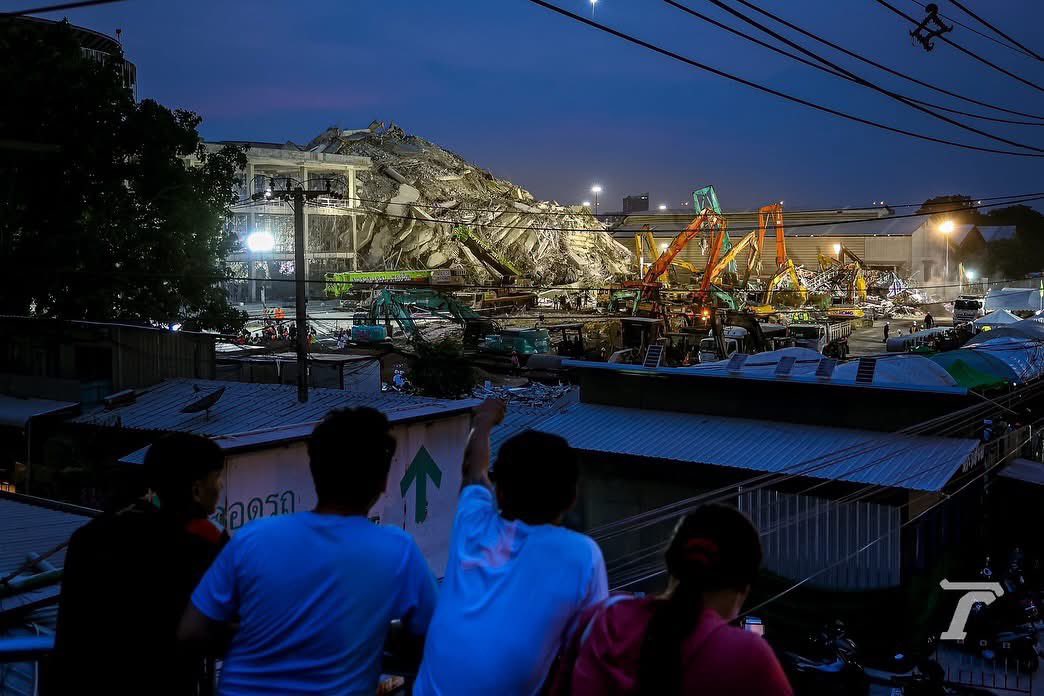
Substandard Steel Found in Collapsed Bangkok Skyscraper, Investigation Reveals
BANGKOK — A shocking 10% of steel reinforcement bars used in the collapsed State Audit Office building failed basic quality tests, investigators revealed today, sending tremors through Thailand’s construction industry and raising urgent questions about oversight of major infrastructure projects.
Substandard Steel Suspected in Deadly Bangkok Skyscraper Collapse
The damning findings come from rigorous testing of 20 steel samples collected from the wreckage of the 30-story tower that pancaked during last Friday’s earthquake. According to Thitipat Chotedechachainan, head of the industry minister’s investigative committee, critical support beams measuring 20mm and 32mm in diameter fell far below required strength standards.
“What we’re seeing is steel that never should have been installed in the first place,” Thitipat told reporters outside the still-smoldering collapse site, where rescue teams continue searching for 77 missing construction workers. The failed materials – whose manufacturers remain mysteriously unidentified – represent what experts call a catastrophic weak point in the building’s structural skeleton.
The Bt2.1 billion project was jointly developed by Italian-Thai Development Corp, one of Thailand’s largest contractors, and China Railway No 10, a Chinese state-owned enterprise. Neither company has responded to requests for comment about the substandard materials, though procurement documents suggest steel was sourced from multiple international suppliers.
[Breaking] The test results of 28 steel samples from the collapsed State Audit Office building in Bangkok's Chatuchak district showed that two did not meet standards, said Nonthichai Likitaporn, director of the Thai Industrial Standards Institute (TISI)’s Standards Division 1.… pic.twitter.com/skTXhcHtLZ
— Thai Enquirer (@ThaiEnquirer) March 31, 2025
At the Iron and Steel Institute laboratory, technicians demonstrated how the faulty rebar snapped under pressure tests that legitimate materials should easily withstand. “This isn’t just below standard – it’s dangerously defective,” said lead metallurgist Dr. Pongsak Lorattawut, holding up a twisted sample.
The revelations have triggered panic across Bangkok’s construction sector, with at least three major developers announcing emergency audits of their active projects. Opposition lawmakers are demanding parliamentary hearings, while the Engineering Institute of Thailand warned the findings may represent “just the tip of the iceberg” in a system plagued by corner-cutting and lax enforcement.
As night fell, floodlights illuminated the grim recovery operation where forensic teams continued documenting evidence. For grieving families keeping vigil behind police barricades, the technical reports offered cold comfort. “They built a tomb, not a tower,” wept the wife of one missing worker, clutching his photo as another body bag was loaded into a waiting ambulance.
Industry Minister’s committee head Thitipat Chotedechachainan confirmed the damning results but stopped short of declaring them the collapse’s sole cause. “These substandard materials couldn’t withstand seismic forces,” she said, noting the findings have been forwarded to the Thailand Industrial Standards Institute (TISI) for potential legal action.
False Earthquake Alarms Spark Chaos in Bangkok as Officials Urge Calm
At the collapse site, where 17 deaths have been confirmed and 77 workers remain missing, rescue teams paused briefly as engineers collected more samples from twisted rebar protruding like broken bones. “Every piece tells a story,” muttered a forensic investigator, bagging a corroded 32mm bar.
-Thailand News (TN)