UK Prime Minister Keir Starmer Resigns Amid Pressure from Labour Party
Keir Starmer announced his resignation as Leader of the Labour Party and Prime Minister of the United Kingdom on Monday, visibly emotional as he acknowledged that he had lost the confidence of his parliamentary group to continue governing. His appearance came after a weekend of reflection on his political future, besieged by pressure following a majority of Labour MPs expressing their support for Andy Burnham, the former Mayor of Manchester, as his successor. Burnham confirmed shortly afterwards that he would stand to replace Starmer.
Britain on High Alert: UK police prepare for more unrest
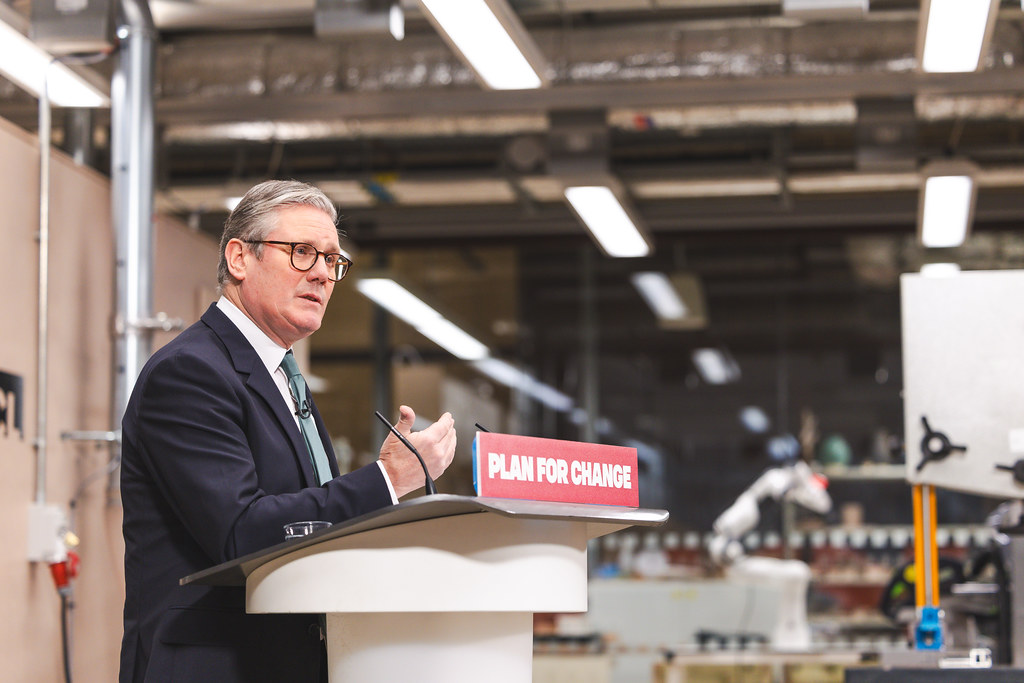
In a statement outside Number 10 Downing Street, Starmer, his voice breaking, said that “the question my party is now asking is whether I am the right person” to lead them until the next general election, scheduled for 2029. After hearing the response from his parliamentary group, he continued, he had “willingly” accepted the decision to “prioritise the country I love.” “That is why I will resign as Leader of the Labour Party. This morning I spoke to His Majesty the King to inform him of my decision,” Starmer said, visibly emotional in front of television cameras, surrounded by his ministers and Downing Street staff.
Starmer, who came to power on 4 July 2024 with an absolute majority in the general election after 14 years of Conservative governments, said he would ask the Labour Party’s National Executive Committee to establish a timetable for the leadership nomination period to open on 9 July and close before the parliamentary summer recess, which begins in the House of Commons on 16 July. “In the event of a leadership contest, this will ensure that there is a new leader before Parliament resumes in September,” he continued. As is customary in such cases to avoid a power vacuum, Starmer will remain in office until the election of a new leader, and on Monday he pledged to give “full support” to his successor. “I will remain as Prime Minister until the election is complete and I will do everything I can to ensure an orderly transition of power,” he assured.
The House of Commons will resume sitting after the summer break on 1 September. By then, the new British Prime Minister is expected to be Burnham, provided he ultimately faces no opposition from other candidates for the Labour leadership. If internal primaries were to take place, the new Prime Minister would assume office at the end of August, according to the British press. This means the United Kingdom will have its seventh Prime Minister in a decade. Since early 2016, Number 10 Downing Street has been occupied successively by Conservatives David Cameron, Theresa May, Boris Johnson, Liz Truss and Rishi Sunak, and Labour’s Keir Starmer, with the seventh now awaiting designation.
Starmer, who spent the weekend with his family at his Chequers country residence outside London, was forced to leave power after Burnham entered Parliament as an MP by winning Thursday’s by-election in Makerfield, in north-west England, a necessary step for a potential challenge to the Prime Minister’s leadership. Burnham, a “charismatic” figure within Labour, confirmed shortly after Starmer’s announcement that he would run to replace the still Prime Minister, for which he would need the support of at least 81 Labour MPs—20% of the parliamentary group—but is estimated to already have at least 200.
What remains to be seen is whether Burnham, who enjoys broad support among Labour MPs, will be the sole candidate to replace Starmer, or whether there will be other contenders. Wes Streeting, who resigned as UK Health Minister in May in protest at Keir Starmer’s government management and had expressed his intention to run for leadership, declared his support for Burnham on Monday. Several British media outlets, including The Observer, The Guardian and The Telegraph, had already reported on Sunday that the UK head of government had decided to resign after a majority of Labour MPs expressed support for Burnham as his successor.
Keir Starmer will go down as the most tyrannical Prime Minister in UK history.
– Attempted to cancel elections
– Removed the right to trial by jury
– Oversaw mothers imprisoned for years over Facebook posts
– Was about to implement digital IDHe should go to jail. pic.twitter.com/8bc3jy8AzY
— Inevitable West (@Inevitablewest) June 22, 2026
US President Donald Trump also took it for granted on Sunday that Keir Starmer would resign and, while wishing him luck, considered that the British head of government had failed on issues such as migration and energy policy. Finally, on Monday, Starmer announced his resignation after receiving pressure from his ministers and MPs following the electoral setback suffered by Labour in the English local elections and regional elections in Scotland and Wales on 7 May.
In his statement alongside his wife Victoria, the Labour leader said that two years ago Labour returned to power after 14 years in opposition, beginning “a new chapter in our country’s history after years of disappointment and despair, the opportunity to improve the lives of millions of people.” “I was told time and again that my party was finished, that we were consigned to history, that a majority in a general election, let alone a landslide, was impossible. But we proved them wrong, because we transformed our party, eradicating the poison of antisemitism, restoring confidence in the economy, defence and national security, and making us a party again,” he argued.
At the helm of a Labour government, in less than two years, Starmer went from winning an absolute majority with the promise of bringing change to the country to becoming tremendously unpopular among the British. A lawyer by profession, with a serious and uncharismatic profile—far from the eccentricities of Boris Johnson—Starmer nevertheless had a long and successful political and public management career as his main asset.
But Starmer’s Labour mandate has been characterised by its lukewarm positioning on controversial issues such as the Palestinian-Israeli conflict, as well as by some highly criticised fiscal and policy decisions, such as cutting pensioner benefits, attempting to limit subsidies for families with three children, or the appointment of former minister Peter Mandelson, who has close ties to convicted American paedophile Jeffrey Epstein, as ambassador to Washington.
Three dead, many injured including several children, after multiple stabbing in north Liverpool
On the other hand, he also advocated restoring relations between the United Kingdom and the European Union, damaged after Brexit, in trade, security and defence matters—without daring to advocate for the country’s return to the EU—and took a leading role in international initiatives such as the so-called Coalition of the Willing, alongside France, to create a possible multinational peace force in Ukraine.
-Thailand News (TN)